Context
20+ Google Sheets managing €2B in receivables across 10 countries. Cash forecasts that moved 50% from one week to the next. Securitisation covenants with lenders who could convert debt into equity if cash positions deteriorated. The company's finance operations weren't just inefficient: they were a systemic risk. DSO lagged industry leaders by a significant margin, with every day of improvement unlocking millions in working capital.
I authored this strategy as Product Manager for Treasury & Cash Automation. It represents the 95% final version, completed just before my departure. The strategy was never executed, but the frameworks, architecture, and thinking are entirely my own.
The Solution
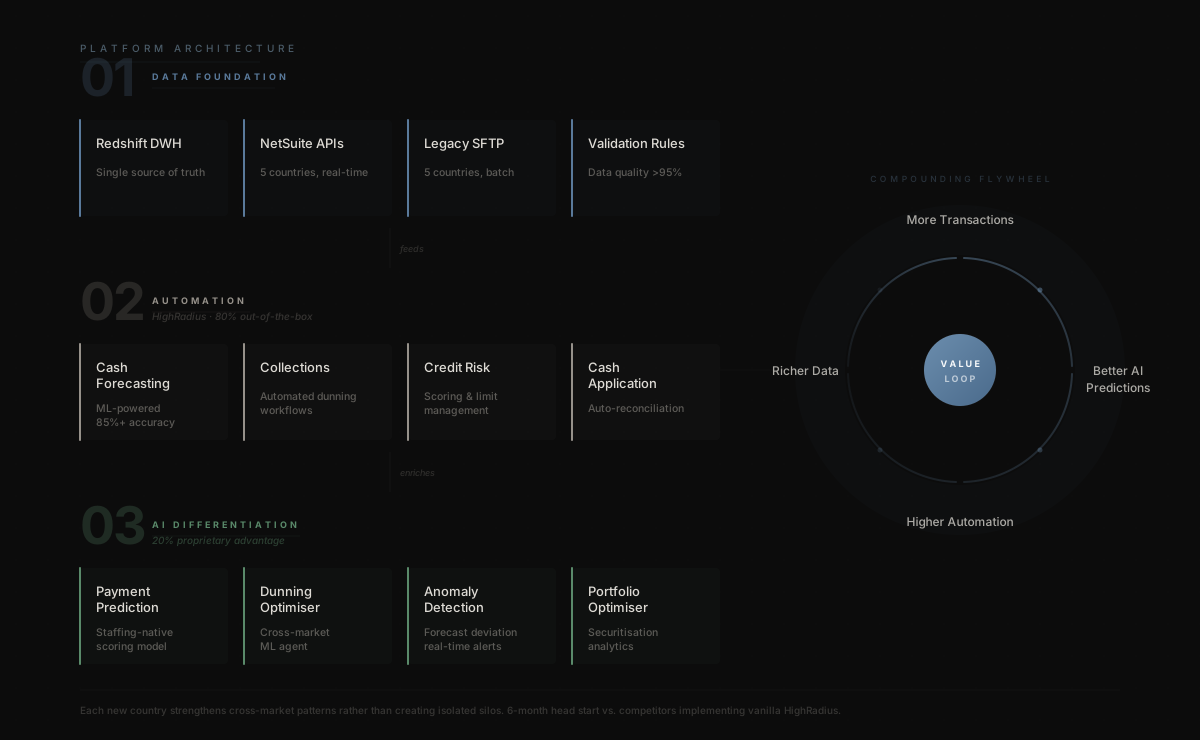
Three layers, one flywheel
The Autonomous Finance Platform combines enterprise-grade automation (HighRadius) with proprietary AI agents trained on company-specific staffing data. The architecture creates a compounding advantage: more transactions produce better AI predictions, which drive higher automation rates, which generate richer data for the AI. Each new country strengthens cross-market patterns rather than creating isolated silos.
Key Frameworks
Competitive Differentiation Architecture
+
The structural advantage comes from three elements that create compounding value:
| Advantage Layer | What We Build | Why It's Defensible |
|---|
| Staffing-Native Data Model | Custom ontology for temp staffing: worker cycles, client payment patterns, seasonal demand | HighRadius out-of-the-box doesn't understand staffing. 12-18 months to replicate |
| Multi-ERP Orchestration | Single abstraction layer across NetSuite + legacy systems with real-time sync | Integration debt becomes a moat: the hard problem competitors avoid |
| AI on Proprietary Data | ML models on 7 years of payment patterns, dunning effectiveness, seasonal cash flows | Training data from 10 countries that no competitor can access |
AI Governance & Human-in-the-Loop
+
Enterprise finance requires the highest standards of AI governance. Every decision type has a defined autonomy level:
| Decision Type | AI Role | Human Approval |
|---|
| Payment prediction scoring | Recommends priority order | No, informational only |
| Dunning email content | Generates draft | Yes, before sending |
| Cash forecast adjustment | Suggests corrections | Yes, Treasury sign-off |
| Credit limit changes | Recommends increase/decrease | Yes, Credit Manager |
Every AI decision is logged with timestamp, input data, model version, output, and confidence score. Payment predictions include the top 3 factors driving the score. All model versions are tracked with 24-hour rollback capability. Decision logs retained for 7 years.
North Star Metric
+
Total Euro Value Influenced by AI-Assisted Actions
A single metric that compounds as each component improves: # Active Users x Tasks per User (weekly) x AI Resolution Rate (%) x Average Euro Value per Task.
Example: 30 users x 50 tasks/week x 40% AI resolution x €500 avg value = €300K/week influenced by platform.
Each component has a clear owner and lever. Change Management owns user adoption. Product Team owns workflow coverage and model accuracy. Customer Success owns enterprise expansion.
Change Management & Resistance Detection
+
AI adoption fails when tools are imposed rather than co-designed. The strategy includes a resistance early warning system that monitors adoption signals weekly:
| Signal | Threshold | Response |
|---|
| Login frequency | <3 logins/week | 1:1 with user to understand blockers |
| Training completion | <80% by go-live | Manager involvement |
| Feature usage | Key features unused after 2 weeks | Targeted micro-training |
| Shadow processes | Parallel spreadsheets maintained | Root cause analysis |
Core message to teams: "AI handles the repetitive work so you can focus on judgment calls and client relationships." Not a replacement narrative. An evolution narrative.
Phased Rollout & Time-to-Value
+
9-month rollout in three phases, designed to prove value early (enterprise buyers expect ROI within 3 months):
| Week | Value Delivered | Outcome |
|---|
| W2 | Real-time AR dashboard | Eliminates 4-hour manual consolidation |
| W4 | Automated daily cash report | Treasury saves 1hr/day |
| W6 | AI-prioritised collection list | Collectors work highest-probability accounts first |
| W8 | Forecast accuracy baseline | First AI vs. manual comparison |
| W12 | Phase 1 Go-Live | DSO improvement measurable |
Scope, Risks & Assumptions
+
In scope: HighRadius implementation (Cash Forecasting, Collections, Credit Risk), integration with 10 ERPs, AI agents for payment prediction and dunning optimisation, dashboards for HQ and local teams, training and change management.
Explicitly out of scope: ERP replacement, Accounts Payable, payroll integration, bank account management, securitisation deal structuring, new country expansion.
The risk register identifies 7 key assumptions with probability/impact ratings and concrete mitigations. Monitoring triggers are defined for each: if any fires, the approach is re-evaluated rather than pushed through.
Full Document (PDF, 22 pages)
Includes user personas, RACI matrix, communication plan, AI risk mitigation, and complete appendices.
Download PDF →
Author's Reflection
Why This Document Matters
This strategy was designed for execution. Organisational changes prevented implementation, but the thinking represents something I believe is rare and increasingly valuable: the perspective of someone who has operated the systems that AI is about to replace.
I spent seven years inside treasury operations at scale. I reconciled cash positions across 10 countries. I built the unit economics models that went to the board. I watched senior finance professionals spend 40% of their time on tasks that a well-designed agent could handle in seconds. That experience taught me something that most AI product managers don't have: an intuitive understanding of where automation breaks down, where human judgment remains essential, and where the real value sits.
The answer, consistently, is in the last 30%. The first 70% of finance automation is straightforward: rules-based workflows, standard reconciliations, templated reporting. The remaining 30%, the exceptions, the edge cases, the judgment calls that require context across markets and counterparties, is where autonomous systems either create genuine value or become expensive mistakes.
I believe treasury will be one of the first enterprise functions to become fully autonomous. Not because the technology is easy, but because the data is structured, the rules are well-defined, and the cost of manual operations is measurable and growing. The transition won't be driven by AI researchers. It will be driven by operators who understand both the domain and the technology deeply enough to design systems that finance teams actually trust.
That is the role I intend to play.